Monday, January 26, 2015

What to look for in a Car for your Teen Driver | Jim Doran Auto Center


If you ask any teenager what they are looking forward to doing the most as they get older, at the top of most lists is probably being able to drive. After all, being licensed to drive gives teens a great sense of freedom – they can now come and go as they please; they are no longer dependent on mom and dad to get them where they need to go.

However, the time when teens begin to drive can potentially be the most deadly. Every dayseven teens ages 16 to 19 die from injuries sustained in a motor vehicle crash. And the crash rate is 3.7 times higher for 16 year old drivers compared to drivers all of all ages, and 2.7 higher for drivers aged 16 to 19.

For parents that are conducting a used cars search for appropriate vehicle options for their teen drivers, how can they help them stay as safe as possible? Here’s a look at five in-car options to look for during their used cars search.

Side Airbags
Although everybody knows about airbags as a safety component in vehicles, some may not realize the importance of side airbags. A study conducted in 2006 conducted by the Insurance Institute for Highway Safety found side airbags that protected driver’s heads helped reduce deaths in cars that were hit on the driver side by about 37 percent.
Electronic Stability Control
ESC works through speed sensors that are placed on all wheels and the steering wheel to help drivers when on roads that are slippery or very curved.

If the ESC system notices the vehicle is about to go in an opposite direction from where the steering wheel is pointed, is will break the necessary wheels to help keep the car under control. ESC can be found vehicles from 2012, and even earlier.

Crash Avoidance Technology
Over the past few years, vehicle manufacturers have unveiled a crop of new applications to help drivers avoid car accidents. These crash avoidance technologies work by providing the driver with warnings, or in some instances even automatically putting on the brakes. Examples of these technologies to look for in a used cars search include blind spot detection, adaptive headlights, lane departure warning, and front crash prevention.
Anti-Lock Brake System (ABS)
An ABS is another safeguard against slippery roads, as well as inexperienced young drives that may find themselves “panic braking” in certain situations. The ABS helps ensure the brakes on a car do not lock up, which could cause a driver to lose control of the vehicle. ABS on the rear wheels allows the vehicle to keep moving in a straight line, while ABS on all wheels allows the driver to maintain steering capabilities.
Seat Belt Reminder System
Although the “ding, ding, ding” that reminds you to buckle up every time you’re in the car can be rather annoying, studies show they do save lives. For instance, a study published in 2008 found 97.5 percent of passengers put on a seat belt when in a vehicle with a reminder system, while only about 86 percent did in cars without a reminder. And teens need all the reminders they can — a 2002 study found that only 69 percent of teens ages 16 to 24 wear their seat belts, and more than two-thirds of teens killed in car crashes were not wearing seat belts.

Wednesday, January 14, 2015

Owning a Used Car: How Much Can You Expect to Pay Each Month? | Jim Doran Auto Center


If you are tempted to cut corners on the purchase of your next used vehicle to save money, you may want to reconsider. Even though you can often find deals to save money up front, it usually comes back to bite you.

Simply put, getting a good deal on a used car spans beyond the purchase price. You also must consider the little things that accompany the monthly payment such as insurance, gas, maintenance and repairs. This may seem like a lot to afford, but it doesn’t necessarily mean you won’t be able to afford the used car of your dreams.

The costs of owning your ride is decreasing as time goes on. On average, the monthly operating and ownership costs associated with owning a sedan is $739.67 (or $8,876 per year), according to a recent report released by AAA. Operating costs include gas, maintenance and tires whereas ownership costs include full-coverage insurance, license, registration, taxes, depreciation and finance charges.

Here’s a detailed breakdown of their findings by vehicle type, based on a 15,000 annual mileage:

If you are blown away by these figures, don’t start worrying yet. Here are some things to consider when shopping that can help you save later on down the line:

Gas

Wouldn’t it be grand if all cars could run off of oxygen? Unfortunately, cars need gas, and gas is expensive. Even hybrids require gas to function. Bummer.

So, when you’re shopping, you’ll need to pay attention to the fuel economy ratings, both on the highway and in the city. Put this expense into your car budget, and see how often you can afford to fill your tank. Even though you can’t control gas prices, you can control how much you spend to fill up your tank each week.

Maintenance

Extended warranties are great, but they typically only cover major repairs. That means you’re on your own with the day-to-day maintenance. It’s probably not a good idea to pick out the shiniest model on the lot without first taking a moment to figure out the anticipated maintenance costs.

Generally speaking, the older the model and the higher the mileage, the more costly the maintenance. You also might want to get the maintenance records to see if the vehicle was properly cared for by its prior owner.

Tires

Don’t forget to take a peek at the tires. If they are extremely worn, they will need to be replaced, which can set you back hundreds of dollars out the gate.

Insurance

Besides the cost of the monthly payment, car insurance is a top expense for your car. Unfortunately, it’s illegal not to carry coverage if you live in any state except for New Hampshire, so insurance is an expense you can’t avoid. But, the year, make and model of your car can affect the cost of your insurance.

Depreciation

Unless you seriously intend to drive the vehicle until the wheels fall off, you’ll want to purchase something that holds value. Otherwise, be prepared to fork over the difference between the sales price and what you owe when you want to sell or trade it in for a new set of wheels. Don’t let bargains on the purchase price fool you. Before putting any money down, look at the current asking price compared to older models to gain some insight on depreciation. And, steer clear of rebuilt or salvaged vehicles if you intend to earn any equity in your vehicle.
Bottom line, there is more to owning a car than just the car payments. You need to set a budget that includes all of the costs so you can see what you can reasonably afford.

Tuesday, January 6, 2015

Winter Driving Tips | Jim Doran Auto Center


Severe weather can be both frightening and dangerous for automobile travel. Motorists should know the safety rules for dealing with winter road emergencies. We want to remind motorists to be cautious while driving in adverse weather. 

We recommend the following winter driving tips:

  • Avoid driving while you’re fatigued. Getting the proper amount of rest before taking on winter weather tasks reduces driving risks.
  • Never warm up a vehicle in an enclosed area, such as a garage.
  • Make certain your tires are properly inflated.
  • Never mix radial tires with other tire types.
  • Keep your gas tank at least half full to avoid gas line freeze-up.
  • If possible, avoid using your parking brake in cold, rainy and snowy weather.
  • Do not use cruise control when driving on any slippery surface (wet, ice, sand).
  • Always look and steer where you want to go.
  • Use your seat belt every time you get into your vehicle.

Tips for long-distance winter trips:

  • Watch weather reports prior to a long-distance drive or before driving in isolated areas. Delay trips when especially bad weather is expected. If you must leave, let others know your route, destination and estimated time of arrival.
  • Always make sure your vehicle is in peak operating condition.
  • Keep at least half a tank of gasoline in your vehicle at all times.
  • Pack a cellular telephone plus blankets, gloves, hats, food, water and any needed medication in your vehicle.
  • If you become snow-bound, stay with your vehicle. It provides temporary shelter and makes it easier for rescuers to locate you. Don’t try to walk in a severe storm. It’s easy to lose sight of your vehicle in blowing snow and become lost.
  • Don’t over exert yourself if you try to push or dig your vehicle out of the snow.
  • Tie a brightly colored cloth to the antenna or place a cloth at the top of a rolled up window to signal distress. At night, keep the dome light on if possible. It only uses a small amount of electricity and will make it easier for rescuers to find you.
  • Make sure the exhaust pipe isn’t clogged with snow, ice or mud. A blocked exhaust could cause deadly carbon monoxide gas to leak into the passenger compartment with the engine running.
  • Use whatever is available to insulate your body from the cold. This could include floor mats, newspapers or paper maps.
  • If possible run the engine and heater just long enough to remove the chill and to conserve gasoline.

Tips for driving in the snow:

  • Accelerate and decelerate slowly. Applying the gas slowly to accelerate is the best method for regaining traction and avoiding skids. Don’t try to get moving in a hurry. And take time to slow down for a stoplight. Remember: It takes longer to slow down on icy roads.
  • Drive slowly. Everything takes longer on snow-covered roads. Accelerating, stopping, turning – nothing happens as quickly as on dry pavement. Give yourself time to maneuver by driving slowly.
  • The normal dry pavement following distance of three to four seconds should be increased to eight to ten seconds. This increased margin of safety will provide the longer distance needed if you have to stop.
  • Know your brakes. Whether you have antilock brakes or not, the best way to stop is threshold breaking. Keep the heel of your foot on the floor and use the ball of your foot to apply firm, steady pressure on the brake pedal.
  • Don’t stop if you can avoid it. There’s a big difference in the amount of inertia it takes to start moving from a full stop versus how much it takes to get moving while still rolling. If you can slow down enough to keep rolling until a traffic light changes, do it.
  • Don’t power up hills. Applying extra gas on snow-covered roads just starts your wheels spinning. Try to get a little inertia going before you reach the hill and let that inertia carry you to the top. As you reach the crest of the hill, reduce your speed and proceed downhill as slowly as possible.
  • Don’t stop going up a hill. There’s nothing worse than trying to get moving up a hill on an icy road. Get some inertia going on a flat roadway before you take on the hill.
  • Stay home. If you really don’t have to go out, don’t. Even if you can drive well in the snow, not everyone else can. Don’t tempt fate: If you don’t have somewhere you have to be, watch the snow from indoors.

Wednesday, September 3, 2014

How Does A HEMI Engine Work?


2014 challenger dodge hemi

What is a HEMI Engine?

Even if you’re not familiar with engine types, by now you’ve more than likely heard of a HEMI. Remember the old commercials where someone would ask, “Hey does that thing have a HEMI?”, or at the very least you may have noticed the silver letters on the side of a vehicle you were next to at a red light that read HEMI.
Lately there has been a lot of talk about the HEMI engine primarily because of the Dodge Challenger and Charger Hellcats, but you may be wondering what a HEMI engine is, and we are here to explain what it is, and how it works.
HEMIs have a reputation of being big, strong, powerful engines which are the primary characteristics of trucks and muscle cars. Looking back to 1948, the HEMI was created, and in 1951 it was able to produce 180-horsepower which was shockingly powerful for this time period. As the years went on, Chrysler tweaked, modified, and increased the size of their almighty engine.
2014 challenger hemi engineIt wasn’t until 1964 that its popularity spread like wildfire when the 7L 426-cu.in. version took first, second, and third place in the Daytona 500 NASCAR race. At this point, the street version could crank out 425-horsepower, but what made this amount of power possible?
What’s unique about a HEMI engine, and what gave it its name, is the combustion chamber on top of the engine that is hemispherically shaped. Going back in time again to the 50’s when most of the cars used a “flat head,” it was entirely different to see Chrysler create an engine with “hemispherical heads.”
A flat head engine is cheaper, and easier to manufacture (used in most lawnmowers actually) because the valves are on the engine block, and open in a chamber next to the piston compared to the HEMI head where the spark plug is on top of the combustion chamber so the valves open up on separate sides of the chamber.
Without becoming overly complicated, this is one of the primary differences, that and the smaller surface area helps the HEMI keep fuel warm which in turn creates more pressure in the cylinder. The bigger the valves, the greater the airflow which is crucial for horsepower.
Fast forward back to present time to where Dodge now has the legendary 6.2L HEMI V8 that is the creator of the 2015 Challenger Hellcat’s roar. To learn more about the power that Dodge vehicles are capable of, including the all-new Challenger and Charger Hellcats, continue reading here.

Monday, August 25, 2014

2015 Dodge Challenger SRT Hemi Hellcat


2015 Dodge Challenger SRT Hemi Hellcat Topeka KS


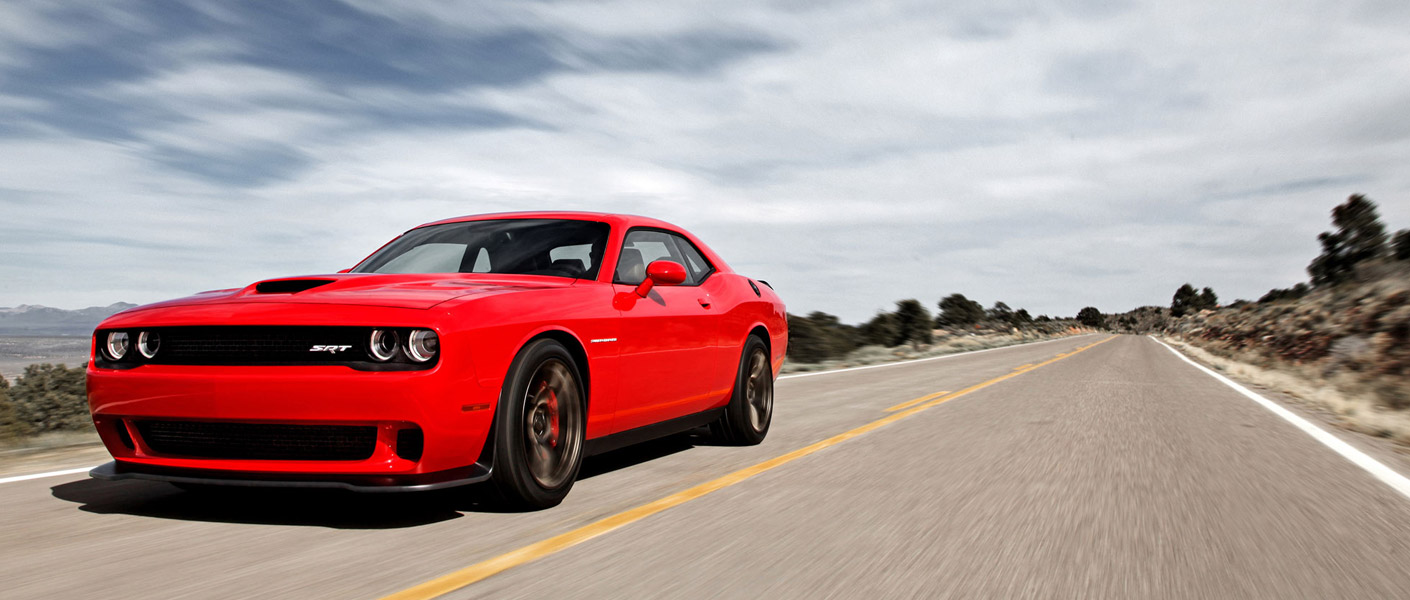
With performance that roars like a lion but makes muscle car lovers purr like a kitten, the all-new Challenger has gone from talk-of-the-town to national news with the confirmation of how many ponies this dream machine is packing. The 2015 Dodge Challenger SRT Hemi Hellcat in McMinnville, OR has godly performance that could make even Hades’ jaw drop

The Dodge core values, power and technology, come alive within the capabilities of the all-new Hellcat whose heart beats with a supercharged 6.2-liter Hemi engine that has been deemed the most powerful V8 engine created by the Chrysler Group. From this point, a split decision must be made between the Tremec 6-speed Manual or the TorqueFlite 8-speed Automatic with wheel-mounted paddle shifters.

How much power does it take to become the most powerful muscle car with the fastest quarter mile drag? The Hellcat answers this with 707 HP paired with 650 lb.ft. torque to be exact. Dodge realizes that this much power must be kept in control and therefore has introduced a red key fob that allows the Hellcat to achieve its full and powerful potential and a black key fob that restricts the Hellcat’s power to 500 HP for more economical daily driving.

7 Defensive Driving Tips

Defensive Driving Can Reduce Motor Vehicle Deaths

learn how to drive defensivelyThe number of fatalities due to car accidents throughout the years has continued to increase, yet recently there has been a slight decrease in the statistics. Still, the total number of vehicle related deaths in 2012 is horrifying, 33,561. Here at Jim Doran Auto Center, we’re passionate about vehicles but more importantly, we care about the driver behind the wheel and believe that defensive driving can reduce motor vehicle deaths.
1. Far too many of these accidents could have been prevented had the driver not been impaired, and even though many of you have heard this far too many times, please do not drive under the influence.
2. Try to avoid all distractions, whether it might be futzing with electronics, juggling a four-course meal on your lap, or turning around to quiet down the kids in the backseat. Taking your eyes of the road for a couple of seconds is enough time to drift, or rear-end someone.
3. We know how irritating it is when the green light switches to yellow and you’re debating whether to accelerate or stop. Running red lights is too much of a risk because other drivers may not be paying attention to you, just the green light for them.
safe driving skills
Always check blind spots before changing lanes.
4. Many of the new vehicles have preventative accident technology, including blind-spot warning detection. Don’t just rely on your mirrors, make sure to look over your shoulder and around your blind spots when turning, motorcycles and low riding vehicles can be difficult to see.
5. As tempting as it might be to “brake check” a tailgater, it’s best to just steer clear. Move over to the other lane if possible. Don’t bother speeding up because they will just push you fast, and you’ll be first inline if a cop is running radar.
6. Allow enough space between you and the vehicle in front of you. No matter how quick your reaction time may be, make sure you have enough room should the vehicle in front of you come to a sudden stop.
7. Roundabouts are one of the most dangerous places on the road because not everyone is familiar with them, especially older drivers and out-of-state drivers.
Be Sociable, Share!